
How VR Is Changing the Gaming Experience
Virtual reality gaming is changing the way people interact with digital entertainment. Traditional video games place players in front of a screen, where they control characters using a keyboard, mouse, or controller. Virtual reality takes a different approach by placing the player inside a three-dimensional digital environment.
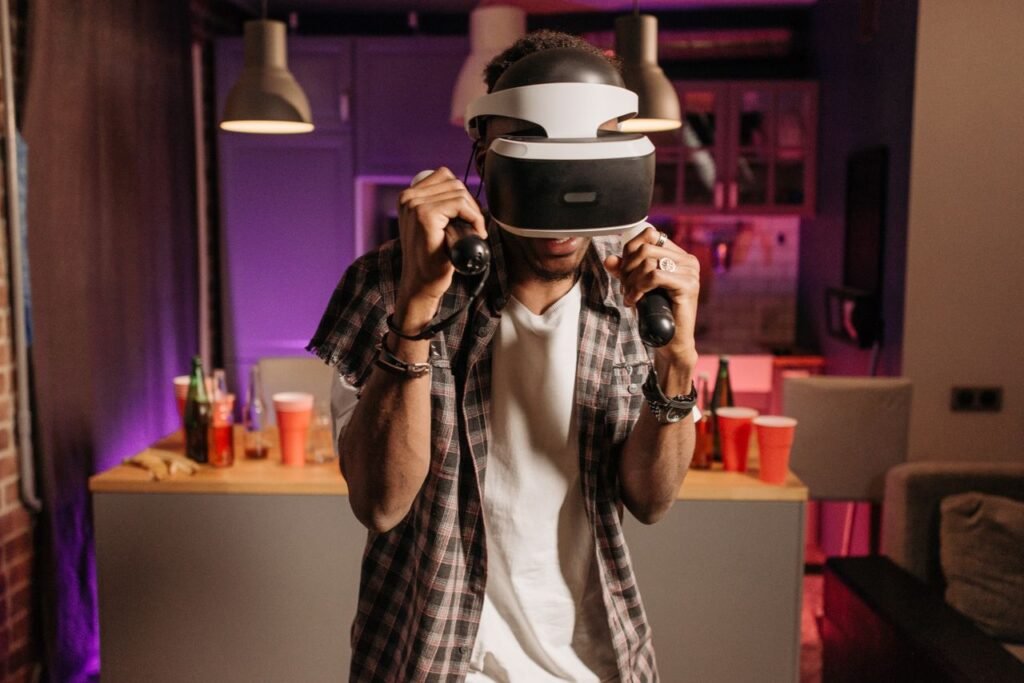
With a VR headset, motion tracking, and specialized controllers, players can look around virtual worlds, interact with objects, move through environments, and experience games from a much more immersive perspective.
What once seemed like science fiction is now becoming a growing part of the gaming industry. As VR hardware becomes more advanced and developers create better experiences, virtual reality is opening new possibilities for gameplay, storytelling, social interaction, and entertainment.
What Is Virtual Reality Gaming?
Virtual reality gaming uses specialized technology to create an interactive three-dimensional environment.
The most important piece of equipment is usually a VR headset. The headset contains displays positioned in front of the player’s eyes, creating the appearance of depth and surrounding the player’s field of view.
Motion tracking allows the system to detect movements such as turning the head or moving the body. VR controllers can also track the player’s hands, allowing them to interact with objects inside the game.
Instead of simply watching a character perform an action, players can often perform that action themselves through physical movements.
This creates a stronger sense of presence and makes the gaming experience feel more interactive.
How VR Gaming Works
A VR gaming system combines several technologies to create an immersive experience.
The headset displays separate images for each eye, helping create a three-dimensional effect. Sensors and cameras track the player’s movements, while controllers allow interaction with virtual objects.
When the player moves their head, the virtual environment responds almost immediately.
For example, if you look to the left in a VR game, the game can display the environment located to your left. If you look upward, the virtual world changes accordingly.
This real-time response is one of the main features that separates VR from traditional gaming.
The Evolution of VR Gaming
Virtual reality is not a completely new idea.
Researchers and technology companies experimented with immersive displays and simulated environments decades ago. However, early VR systems were often expensive, uncomfortable, and limited by the technology available at the time.
Modern VR became more accessible as display technology, motion tracking, computer processing, and sensors improved.
The development of consumer VR headsets helped introduce virtual reality to a much larger gaming audience.
Today’s systems can provide higher-resolution displays, improved tracking, better controllers, and more comfortable designs than many earlier attempts.
The technology continues to evolve, making VR increasingly practical for home gaming.
VR Creates a Stronger Sense of Presence
One of the biggest advantages of virtual reality is presence.
Presence refers to the feeling that you are actually inside the virtual environment rather than simply looking at it through a screen.
Traditional games can be highly immersive, but the player remains physically separated from the digital world.
VR reduces that separation.
When players can look around naturally and interact with objects using their hands, the virtual environment can feel more immediate.
This can make ordinary gaming activities feel completely different.
Walking through a virtual forest, exploring a futuristic city, or standing inside a fantasy environment can become a much more personal experience.
VR Changes Game Controls
Traditional games rely heavily on buttons and analog sticks.
VR introduces physical interaction.
Instead of pressing a button to pick up an object, players may reach toward it and use a controller to grab it. Instead of moving a camera using a joystick, players can look around naturally.
This creates new possibilities for game design.
Developers can create mechanics based on physical movement, hand positioning, gestures, and spatial awareness.
The result can be games that feel fundamentally different from traditional console and PC experiences.
Immersive Storytelling
VR can also change the way stories are presented.
Traditional games usually control the camera from a fixed or player-controlled perspective. VR allows players to look around the environment independently.
This can make storytelling more interactive.
A player might hear a sound behind them and turn around to discover an important event. They may walk through an environment and discover details that would be easy to miss in a traditional game.
Developers can use spatial audio, environmental design, lighting, and player movement to tell stories in new ways.
Instead of simply watching a story unfold, players can feel as though they are physically present within it.
VR and Horror Games
Horror is one genre that benefits significantly from virtual reality.
Traditional horror games can create fear through sound, visuals, atmosphere, and unexpected events.
VR adds another layer of immersion.
Being surrounded by a dark virtual environment can feel more intense when players can look in every direction. A sound coming from behind can encourage the player to physically turn around.
This creates a much stronger emotional response for some players.
However, the increased intensity of VR horror can also make these experiences unsuitable for people who are uncomfortable with highly immersive environments.
VR in Multiplayer Gaming
Virtual reality is not limited to single-player experiences.
Multiplayer VR allows players to interact with other people inside shared virtual environments.
Instead of simply seeing usernames or characters, players can see avatars representing other participants.
They may communicate using voice chat, gestures, and physical movements.
This can create a stronger sense of social presence.
Friends can meet inside virtual spaces, play games together, participate in activities, or explore environments as a group.
As VR social technology improves, multiplayer experiences could become an increasingly important part of the industry.
Fitness and Active Gaming
VR has also introduced new possibilities for physical activity.
Traditional gaming often involves sitting for long periods, while some VR games encourage players to move their bodies.
Players may need to dodge obstacles, swing virtual objects, reach toward targets, or move around an environment.
Some VR experiences are specifically designed around exercise and physical activity.
This combination of gaming and movement can make exercise feel more entertaining.
However, players should still use VR safely and take appropriate breaks, especially during longer sessions.
VR and Different Gaming Genres
Virtual reality can work across many different genres.
Action Games
VR can make combat and movement more interactive by allowing players to aim and interact physically.
Racing Games
VR racing can provide a strong sense of sitting inside a vehicle, with players able to look around the virtual cockpit.
Simulation Games
Simulation titles can benefit from VR because players can interact with detailed environments and equipment.
Adventure Games
Exploration can become more immersive when players can physically look around and interact with the environment.
Puzzle Games
VR can introduce spatial puzzles that require players to manipulate objects from different angles.
Horror Games
VR can intensify atmosphere and suspense through immersive environments and spatial audio.
The flexibility of VR gives developers opportunities to experiment with mechanics that would not work as well on traditional screens.
The Importance of Motion Tracking
Motion tracking is a critical part of the VR experience.
The system needs to understand where the player’s head and hands are located in physical space.
Accurate tracking allows virtual objects to respond naturally to movement.
If tracking is inaccurate or delayed, immersion can be reduced.
Modern VR systems have made significant improvements in tracking technology, but performance can still depend on the hardware, environment, lighting, and software.
Better tracking will remain an important area of development.
Challenges of Virtual Reality Gaming
Despite its advantages, VR gaming still faces several challenges.
Hardware Costs
High-quality VR systems can be expensive, particularly when additional accessories or powerful gaming hardware are required.
Comfort
Some players may experience discomfort when wearing a headset for extended periods.
Motion Sickness
Certain VR experiences can cause motion sickness because the visual system and physical movement may not always match.
Physical Space
Some games require enough room for players to move safely.
Battery Life
Wireless VR devices depend on batteries, which can limit long gaming sessions.
Limited Game Libraries
Although the VR game library continues to grow, it is still smaller than the libraries available for traditional gaming platforms.
These challenges are important factors developers and hardware manufacturers need to address.
How Developers Are Adapting to VR
Creating a VR game is different from creating a traditional game.
Developers must consider the player’s physical position, field of view, movement speed, comfort, and interaction methods.
Poorly designed movement systems can increase discomfort.
Developers therefore experiment with techniques such as teleportation movement, adjustable turning systems, comfort settings, and customizable controls.
User experience is especially important because VR places the player directly inside the game world.
The Future of VR Gaming
The future of virtual reality gaming looks promising.
Headsets are becoming more advanced, while improvements in displays, processors, tracking systems, and wireless connectivity could make VR more comfortable and accessible.
Future systems may become lighter and easier to wear for longer periods.
Hand tracking and other forms of natural interaction could also reduce the need for traditional controllers.
Artificial intelligence could further enhance virtual environments by creating more responsive characters and dynamic experiences.
As these technologies develop, VR could move beyond being a specialized gaming platform and become a more common part of digital entertainment.
VR and the Future of Game Design
Virtual reality may influence game design even outside traditional VR games.
Developers are learning new ways to create environments, interactions, and storytelling systems that prioritize immersion.
These ideas could eventually influence other forms of gaming.
The broader lesson is that players are increasingly interested in experiences that feel interactive and personal.
VR represents one of the strongest examples of this shift.
Is VR the Future of Gaming?
VR is unlikely to completely replace traditional gaming in the near future.
Consoles, PCs, smartphones, and handheld devices all offer different advantages.
Many players prefer traditional screens because they are simple, comfortable, and convenient.
VR is better understood as another major gaming platform rather than a complete replacement for existing systems.
As technology improves, players will have more choices about how they experience games.
Some may prefer traditional gaming, while others may enjoy the immersive possibilities offered by VR.
Conclusion
Virtual reality gaming is changing the gaming experience by allowing players to interact with digital worlds in a more direct and immersive way.
VR headsets, motion tracking, spatial audio, and interactive controllers give developers new tools for creating games that feel different from traditional screen-based experiences.
The technology has already influenced genres such as horror, racing, simulation, adventure, and multiplayer gaming, while also creating opportunities for fitness and social interaction.
There are still challenges to overcome, including cost, comfort, motion sickness, hardware limitations, and the size of VR game libraries. However, continued innovation could make VR more accessible and enjoyable for a wider audience.
As gaming continues to evolve, virtual reality is likely to remain an important part of that transformation. Whether it becomes the dominant form of gaming or continues alongside consoles and PCs, VR has already demonstrated that the future of gaming can be far more immersive than simply sitting in front of a screen.